You need wheels for a pallet jack.
Have you ever gone online or studied a catalog and thought "Aren't all pallet jack wheels the same?" or "I have no idea what I need!"? Or maybe you service pallet jacks and the wheels just are not lasting as long as you (or the person paying the bills) would like?
In this post, we are going to take a look at the different load wheel options we offer, and their pros and cons.
Load Wheel Options;
Polyurethane and Ultra-Polyurethane treads are the most common wheel treads you'll encounter on a pallet truck.
Polyurethane (Poly) Tread Wheels: These have a chemical bond that secures the poly tread to a steel core (or hub). This option is ideal for display floors, carpeting, and warehouses. They mark floors the least while rolling easily and quietly. Under really heavy loads (2,500lb +), if left to sit more than 8 hours, there is a possibility of the wheels flat spotting.

Ultra-Poly Wheels: Longer lasting and they roll more easily than regular poly, also a chemical bond on a steel core. Ultra-poly is very hard and won't shatter like nylon if too cold (i.e. in and out of a freezer). They are also non-marking with the possibility of flat spotting, as mentioned above.

Nylon Wheels: This is a harder material that is best for cold storage applications. It is also the material of choice for use in environments that may cause rust or corrosion like poultry processing, and working with seafood. It can also be the best choice for refrigerated transport trucks that have the grated floors. Lastly, they can be a good choice if the pallet truck is taken outside on rough pavement. These are however more likely than poly to mark floors, so be mindful when using inside a showroom or a hotel lobby, for example.

Steel Wheels: When all else fails you may need solid steel wheels. These are best for use on factory floors where there may be metal shavings or hard debris on the floor, and where noise is not an issue. What they lack in their ability for use in a sneak attack (they’re pretty loud) they make up for in sheer durability. These are also a good choice if you need to work outside on rough asphalt. But they can damage nice floors, so avoid use on floors you want to remain "pretty".
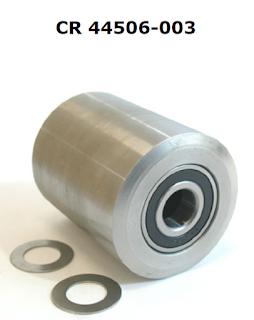
One Wheel or Two?
Now that you've got an idea of which type of wheel is best for your specific uses you are faced with another sometimes tough decision. One wheel or two?
First, most pallet jacks have two load wheels. One load wheel is located under each fork. At times you'll have what's called a tandem assembly which means there are two wheels under each fork but they share the same bracket.
Unless a pallet jack is brand new, we always recommend replacing both load wheels at the same time. No, we are not just trying to up-sell you! There is a legitimate benefit, so hang on with me for a little longer. Have you ever gone to have the tires on your vehicle replaced and told the sales guy you only wanted one? You probably got the funny squinty eyes from the sales guy for this same reason.
Load wheels wear down and get shorter the longer you have used them. Load wheels (like pallet jack steer wheels or the tires on your car) do not act independently but are a portion of a larger machine. Even a little difference in diameter causes stress on the mating (aka connected) parts which then causes issues down the line. One example would be of the pivot axles that are located the load wheel brackets eating through the bushings, or egging out the holes in that bracket or where they articulate (attach) in the fork frame. You may not notice there is an issue until something breaks, or you go to replace that originally unchanged wheel and find you need a whole new bracket on one or both sides.
Trust us that replacing the whole load wheel bracket is more time consuming and expensive than choosing two wheels during regular maintenance.
Because we so strongly advocate changing both at the same time we created wheel kits to get you everything you need, and they are priced lower than the two wheels by themselves. Here is an example - - GWK-BF-LW

Extra Resources
Here are some more links you may find handy as you venture down the road of replacing your load wheels


